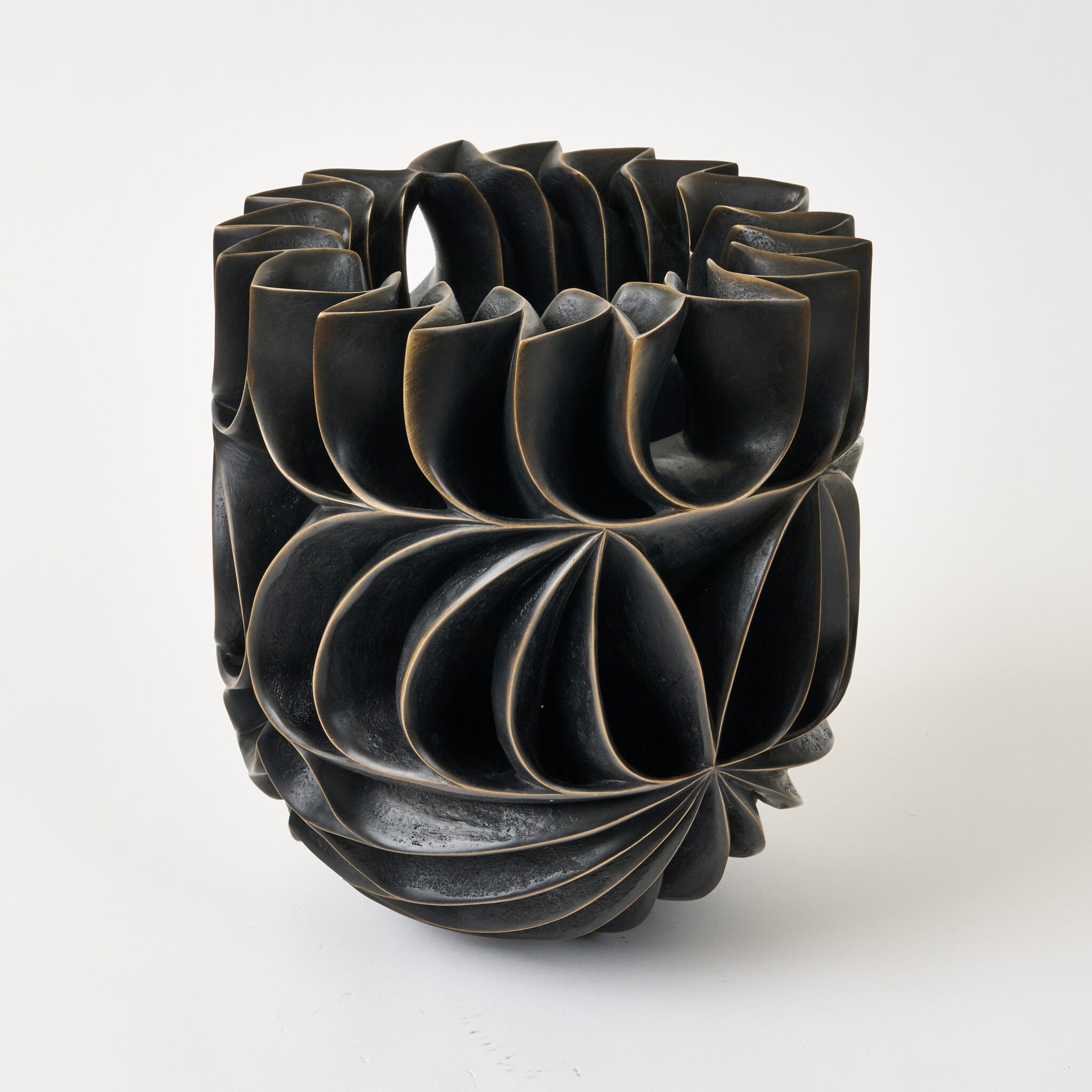
JOANNA BIRD IS DELIGHTED TO BE PRESENTING an exquisite curation of works for her twenty-second year of exhibiting at COLLECT.
This year, the Gallery will be showcasing a diverse range of studio ceramics and glass pieces by a group of international artists curated through the lens of installation. Our 2026 cohort explore the varying demands of scale, light and functionality within architectural and domestic contexts.
Through the unique materials and disciplines of their makers, each of the exhibited pieces reflects a deep engagement with how objects inhabit and transform space. Contrasting rhythm and order with organic forms and rich texture, our artists’ works embody both continuity and evolution within contemporary studio practice, celebrating innovation, material experimentation, and a dynamic dialogue between emerging and established makers.
The exhibition will feature artists including Adam Buick, Halima Cassell, Amanda Coldridge, Steffen Dam, Florian Gadsby, Petra Lindenbauer, Francis Lloyd-Jones, Hattori Makiko, Matthew Warner and Gregory Warren Wilson.
Celebrated works by studio pottery and glass masters, including Norah Braden, Elizabeth Fritsch, Lucie Rie, Rupert Spira, William Staite Murray and John Ward will also be on display.
COLLECT is the leading international fair for contemporary craft and design to be held at Somerset House, London, from 27th February–1st March 2026, with previews on 25th and 26th February.
Please click on the images for more information on each piece.
Norah Braden was one of the foremost British potters of her time. After graduating with a diploma in painting at the Royal College of Art, she studied at the Leach Pottery from 1925 to 1928, where she became particularly interested in wood ash glazes. She subsequently worked alongside Katharine Pleydell-Bouverie at Coleshill for eight years, using ash glazes made from plants and wood on the estate.
She taught at Brighton and Central Schools of Art. Braden was a perfectionist, and destroyed many of the pots she made, to the extent that her work is now considered rare. She was thought by Leach to have the best eye of any of his pupils and is considered by many to have the greatest sensitivity to shape of any of the Leach pupils.
Adam Buick’s work focuses on perfecting the singular, universal foundation of his practice, the Korean moon jar, the perfect symmetry of which denotes Confucian ideals of simplicity, humbleness and purity. Yet, for Adam, the moon jar form is not an end in itself, but rather a canvas, a world onto which he maps a deeply personal exploration of how humans make sense of the landscape in which they live.
For Adam, this landscape is the St David’s peninsula in his native Pembrokeshire, where he continues to live and work today. Having originally studied Archaeology, Adam is an innovator in incorporating locally sourced materials into his work, clay dug from the moors of Waun Llodi, sand and stone from the beach, even bone fragments. In this, each of Adam’s pieces is completely unique with its own history and geology. Adam has produced many installations in which his beloved landscape plays an active role in their creation, leaving pieces out on the beach and mountainside to be gently transformed by rain, mist and wind. The Welsh concept of Cynefin encapsulates this profound sense of physical, cultural and spiritual belonging.
Born in 1975 in Pakistan, Halima’s multicultural background is tangibly present in her work. A natural creativity presented itself at an early age and was nurtured to fruition through an undergraduate degree in 1997 and an MA in 2002. Since then, she was appointed an MBE in 2021 for Services to Art. She is also an Elected Fellow of the Royal British Society of Sculpture.
The culmination of this education is Halima’s precociously mature work. Fusing her Asian roots with a fascination for Mughal and African pattern work and a passion for architectural geometry, Halima’s work is intense yet playful, structured yet dynamic; substantial yet fluid and invariably compelling in its originality.
In Halima’s work she combines strong geometric elements with recurrent patterns and architectural principles, strong lines and dramatic angles. Halima concentrates on simple forms as the basis of her work in order to maximise the impact of the complex contours of the patterned surface.
A pot can last for a thousand years. Unchanged by time, these material remains are unearthed in much the same condition as they were originally made, preserving a specific moment of creation from beyond the veil of history. Discovering Amanda’s work, however, one feels as though her pieces have lived each moment of the changing seasons, evolving, decaying, and emerging again transformed.
Amanda is engaged in creating work that reflects the natural mark-making and change that occurs through simply being. Her approach is highly experimental, layering slips, glazes, and fabrics to create layers of texture, often refiring pieces several times to create her desired effect.
‘I am not trying to create perfection but to play with the beauty of imperfection and experiment with how far I can push the clay to give me the effect I am looking for. It is based on instinct and the feeling I get when I look at a creation. If I don’t get that glow of happiness or feeling of excitement, I collapse the clay in my hand and start all over again.’ – Amanda Coldridge
Steffen Dam (born 1961) is full of contrasts. On one hand he is rational and analytical, a technical genius and a perfectionist. On the other hand, he is a conductor of chance, sensititve to the poetry of life and the fluidity of glasswork. It is exactly this ambiguity of rationality and irrationality, logic and poetry, which constitutes the essence of his art.
These Specimen Jars, as well as the Cabinet of Curiosities for which Steffen is best known, perfectly encapsulate his philosophy. Made of blown and lampworked glass ensconced in a solid glass ‘jar’, these forms seem at once familiar and otherworldly. Standing before his installation the viewer recognises the biological and scientific references, and nevertheless constantly questions is this real or is it fake? In this way, Steffen’s installations invite the viewer into a world of fantasy and delight.
‘Many people see glass as a hard, brittle, shiny material. I don’t see it that way at all. To me it is a liquid –a liquid that I can make run in any direction.’ – Steffen Dam
Elizabeth trained as a harpist and pianist before taking up pottery in 1966, and this deep understanding of music and rhythm greatly informs her work. Inspired by the early Renaissance frescos of Piero della Francesca and the work of Russian Constructivists including Malevich, she never uses glazes and instead employs coloured slips for her painterly decoration.
Elizabeth understands and plays with perspective in a way few artists can achieve; drawing on her extensive personal research into archaeology, philosophy, world literature and quantum physics, she creates surreal vessel forms that appear to transcend their 3 dimensional nature. At once intimate and monumental, her use of melodic line and harmonic colour place her pots in what she often calls the 21/2 dimension. In this regard, every edge, angle and curve is clearly considered and articulated.
In 1971, Fritsch had her first solo show at Bing and Grondahl porcelain factory in Copenhagen, where she won a major prize in the Royal Copenhagen Jubilee competition. In 1987, she was chosen for Bernard Leach’s Centenary Post Office Stamp issue alongside her former mentors Hans Coper and Lucie Rie. Since then, she has won several prestigious awards and had many solo exhibitions, including at the Fine Art Society in 2008, which was curated by Joanna.
Florian Gadsby has studied under some of the household names of contemporary ceramics. Having trained in Thomastown, Ireland, he later went on to apprentice under Lisa Hammond MBE at Maze Hill Pottery London, and under Ken Matsuzaki in Mashiko, Japan. Florian says this education in the Studio Pottery tradition taught him the discipline it takes to run a successful studio, often working over 80 hours over a six-day week.
An accomplished thrower, he specialises in making functional ceramics for daily use. His finely turned architectural style is exactingly precise and rigorously refined, resulting in light, angular forms of a quiet sensibility. He often complements his pieces with feldspathic, reduction-fired glazes which produce a soothing and rich crystalline effect.
Today, Florian innovatively documents his meticulous process online, and in doing so has garnered a following of millions and engaged a generation of new audiences in the question of what it means to be a craftsperson in the modern age. He recently published his first book, By My Hands: A Potter’s Apprenticeship.
As the daughter of a sculptor, Petra Lindenbauer understands the importance of gesture and asymmetry in her work. Her ceramics question how immaculately an object must be executed, and what the non-finito, traces of creation, use and care, can bring to the vitality of an object. Rather than seeking flawlessness for its own sake, Petra is attentive to the impulses of the material. She seeks to capture the moment of genesis, the moment of letting go, when the inner life of the clay begins to resonate.
‘I have no desire to dominate the material, even less to subjugate it… my wish is to encourage the clay to reveal what it has retained during the process of coming into being, and to transform itself in my hands into an object’ – Petra Lindenbauer
Perhaps Francis Lloyd-Jones’ refined his sensibility for rhythm and form during his training at Thomastown, Ireland, or as an apprentice to Lisa Hammond MBE. Likely it has its roots much earlier: his mother and grandfather werer both successful potters themselves. This early education, immersed in the language of objects, has given Francis’ work a subtle novelty that is at one recognisable and refreshingly new.
His work, domestic ware that is intended to embellished life, is often salt-glazed and reduction-fired, lending it a tender strength and a mellow depth that retains an air of mystery. His pieces reveal themselves slowly. They must be felt, held through a lifetime of use, to be understood and enjoyed thoroughly.
Francis currently works as the resident potter at the Farmers’ Arms in Cumbria. A subsidiary of Grisedale Arts, it has become an acclaimed and influential model for a new kind of art institution, underpinned by the philosophy that art should benefit the wider community.
Hattori Makiko (Born 1984) is a Japanese ceramic based in Gifu, Japan. She works in Seto porcelain, covering her forms with tens of thousands of minute porcelain ribbons to tightly fill the surface of the entire pot and its interior. This work is so fastidiously covered in clay that it take six months to effectively dry and as such Makiko produces only eight to ten works per year. She prefers to work in a meditative state on this repetitive procedure.
Makiko says this about her work:
I would be happy if the audience can immediately be drawn into the work before any other explanation because of the visual and tactile impact of the surface.
The work involves a repetitive process, nonetheless I never get tired with this Zen-like operation. I confront this long procedure with a very relaxed transcendent state of mind.
Born in Vienna, Lucie Rie (née Gomperz) studied ceramics at the Wiener Kunstgewerbeschule under Michael Powolny and Robert Obseiger from 1921 to 1926. She showed her work in various exhibitions concerned with the products of the Wiener Secession, including the Paris exhibitions of 1925 and 1936. She arrived in England in 1938 and established her studio in Albion Mews, West London, where she remained for the rest of her working life.
Her earliest English works were ceramic buttons, brooches and tableware, which she made with the assistance of Hans Coper after the Second World War. However, once wartime exigencies and immediate post-war austerities were over, Rie was free to develop her work, bringing to it an infallible sense of style combined with a certain ‘English’ sense of balance between form and surface.
Even after Hans Coper left to set up his own studio in 1958, they continued to exhibit together and their work, although very different, represented a new departure from the Eastern influences that until then had been the British studio potter’s sole source of reference. Lucie Rie’s work is to be found in numerous major public collections, as well as many private ones.
Rupert Spira was born in London in 1960. He gained a degree at West Surrey College of Art and Design from 1978 – 80 under Henry Hammond and later trained with Michael Cardew at Wenford Bridge Pottery. In 1996 he set up his own studio at Church Farm, Shropshire.
The skill of throwing on a potter’s wheel is the basis of Rupert Spira’s work. Having been the apprentice to some major ceramic artists he sets very high standards in the craft of his art – making things larger and with extraordinary attention to detail than one might anticipate.
The versatility of his skills mean that works vary in scale from miniature to monumental and in decoration from monochrome to intricately hand-written texts. Rupert also painstakingly applies raised texts to some pieces, and in some cases poetry he has written himself.
William Staite Murray was born in Deptford, London. He attended pottery classes at Camberwell College of Art from 1909 to 1912, and set up his own pottery in Rotherhithe, London, in 1919. He was appointed Head of Ceramics at the Royal College of Art, London, in 1926.
Staite Murray was one of the most celebrated, influential, and successful British studio potters in the years before the second world war. He exhibited in fine art galleries with painters and sculptors, and his work commanded high prices for that time. He considered himself to be a fine artist and distanced himself from the folk craft tradition of his potting contemporaries. However, like Bernard Leach he looked to the East, finding aesthetic inspiration in the Oriental ceramic tradition, and spiritual sustenance in Buddhism.
Stylistically, his work is distinctive. He worked in stoneware and earthenware, threw large pots and often left the throwing marks visible as expressive features even though he turned the feet. He built his own gas-fired kiln, and applied rich glazes in stony and mossy greys and browns. His brushwork often consisted of a few abstract strokes which tended to enhance the form. He thought of his pots as inhabiting a space midway between sculpture and painting.
Born in 1938 London, John Ward is regarded as one of Britain’s greatest potters. Influenced by ancient pre-glaze pottery from China and Cypress he was inspired by more modern influences such as Hans Coper’s formal strength, Lucie Rie’s colour palette and Ian Godfrey’s playful textures.
In 1966 Ward was accepted onto the Camberwell School of Art and Crafts Ceramics course after developing a fascination with pottery during Adult Education classes. After graduating he worked as a part time pottery teacher in London while also developing his studio. In 1979 he moved to Pembrokeshire where he still resides and works.
‘There is something compelling about the making of pots, regardless of function, which keeps me within the particular sphere; they are the focus of some many interests and associations. My aim is to make pots which have simple forms with integral decoration and aspects which can interact with the environment in interesting ways; to try and express a balance between these dynamic qualities and a sense of stillness or containment. Form above all, but expressed through light and colour’ – John Ward
Matthew Warner completed his BA at Camberwell College of Art in 2010, before going on to study under Julian Stair as a QEST Scholar.
His work takes inspiration from the 18th-century potter Josiah Wedgwood, and seeks to explore how perceptions of status and luxury are reinforced through objects. He is particularly interested in the social connotations of pots throughout history, and in how they have been deployed to promote ideas of class, power, and even moral understanding.
Pots fascinate me because they embody and articulate so much information about society and culture. They are relics or signals of taste, social behaviour and cultural history. Their forms are incredibly diverse and at the same time carry a universal understanding. These everyday objects span social divides and convey very concentrated messages about their environment. I am particularly interested in the social connotations of these objects throughout history and more specifically how they have been deployed to promote ideas of class, power, and even moral understanding.
A frame is often, by nature, marginal. It compliments, decorates and adorns, but rarely is it integral to the work of art within. Yet for Gregory Warren Wilson’s works in glass, his deep, bespoke frames are an essential and ubiquitous feature. Each frame serves as an arena, a theatre, in which the two vital qualities of glass, light and colour, can play and interact in novel ways. Layers of hand-cut glass, sometimes as many as six, are arranged so that the light penetrates and refracts in three dimensions, turning the two-dimensional nature of a framed image on its head. One can think of Gregory’s work as a sculpture, the frame an intrinsic part of its architecture.
Gregory is also an award-winning poet, having published six collections to date. Many of his pieces unfold from a fragment of poetry to become abstract, figurative works in their own right. What is striking about Gregory’s pieces is that they retain a narrative quality. Rhythmic yet asymmetrical, moving but still, they are a landscape in which the interplay of colour and light plays out like an event. Light and shade seem to dance as the eye travels, and the darkest colours often glow with the greatest intensity. It is this experience of perspective, of the subjectivity of light and colour, that Gregory wants us to think about. Can the subjective and objective ever be reconciled?