Somerset House, The Strand, London, WC2R 1LA
JOANNA BIRD CONTEMPORARY COLLECTIONS has exhibited at Collect every year since it began in 2004. This year, the Gallery will bring together an international ensemble of visionary artists in a celebration of contemporary studio glass. United by an enduring modernity, yet distinct in voice, each piece offers a fresh perspective on the expressive potential of glass, revealing its endless capacity for innovation.
The exhibition will feature artists, each of whom is highly accomplished in their field, including Steffen Dam, Katya Izabel Filmus, Joseph Harrington, Laura de Santillana, Kaja Upelj and Gregory Warren Wilson.
COLLECT is the leading international fair for contemporary craft and design to be held at Somerset House, London, from 28th–2nd March 2025, with previews on 26th– 27th February.
Please do not hesitate to request further information. Prices range from £1,500 to £60,000.
For those of you not able to join us in person this year, please enjoy this short video of our stand this year.
I have been interested in the Cabinet of Curiosities for many years.
The Cabinet of Curiosities is a very old invention, dating back to around 1500 AD. But all the things you see back then are fake biology; none of it is real, and it doesn’t look like anything that you can find in the real world. And yet it looks quite a bit like the original. So we have this constant play on ‘is this true or is it fake?’
Many people see glass as a hard, brittle, shiny material. I don’t see it that way at all. To me it’s a liquid – a liquid I can make run in any direction. I can make it stretch or I can compress it, I can stop the process of it moving in any position. So, to me it’s a soft material. I think that’s very different to most people’s idea.
Collect is a great thing from a Danish artist’s perspective, simply because it attracts people from all over England – and, in fact, all over Europe – who are genuinely interested in what is being presented there. For me, Collect is a great opportunity to meet those people and to be able to take the next step in continually improving my work.
Glass is an incredibly versatile material, and I’m constantly fascinated by its ability to take on so many forms. It’s contradictions – elegance versus fragility, lightness versus tension, beauty versus danger – make it both challenging and compelling. Every time I work with it, I discover something new. Its potential for innovation always offers new insights into form and meaning.
My work explores memory and its connection to the body, especially concerning immigration and displacement. Glass as a medium serves as a metaphor for the fragility of memory and identity. Black glass, drawing on the most primal form of natural glass, obsidian, is particularly symbolic of these origins of identity.
The word Omphaloskepsis derives from the Ancient Greek ‘omphalos’, meaning navel, and ‘skepsis’, meaning viewing or examination. Navel-gazing, therefore, is the contemplation of one’s navel as an aid to meditation.
In ancient cultures, the navel was considered the point of contact between mother and baby. It represents the channel of life and energy transmitted between the two, but ultimately, it is the scar left behind at birth. At the central point of the human body, it evokes the connection between generations. I imagine it as a time capsule for future excavation: an archaeological preservation of the self.
Joseph Harrington’s conceptual use of glass is unique. He has pioneered the lost-ice process, using salt to degrade large ice blocks into a state where he can carve a unique and ephemeral model from which he takes a direct cast. The textures this produces are intriguing and the inner life of the glass reveals layers of fusion and quasi-geological formations.
His forms relate to landscapes that have inspired him, rocky coastlines, geological strata and glacial phenomena. Joseph has to work fast in order to capture the exact moment when he is satisfied with the form in its melting state. Then, after another session in the deep freeze, the plaster mould can be made and becomes the container for the hot molten glass.
I aim to harness the transience of the process and the fluidity in texture that it provides. Not trying to suspend time or stop it, but give a sense of gradual progression, like the creaking of an iceberg or the erosion of a riverbed. It is a more meditative viewpoint; if you leave the sculpture, will it have changed when you look back? – Joseph Harrington
Laura de Santillana (1955–2019) was born in Venice and trained in New York, where she also worked at the Vignelli studio. From 1975 to 1985, she designed objects and lamps for Venini, the renowned glass company founded by her grandfather, Paolo Venini. Many of her designs from this period are now part of prestigious collections worldwide.
She is an internationally renowned glass artist who continually pushed the boundaries of her medium. Initially expected to lead Venini, her path took a new direction when the company was taken over in 1985. This unexpected turn freed her from familial obligations, allowing her to pursue her own artistic vision while remaining deeply connected to the Murano glassmaking tradition and heritage. Laura’s early acclaim came from her Murano “tablet” pieces—delicate yet sophisticated sculptures. However, in the last six years of her life, she experienced a renaissance in Nový Bor, further shedding limitations as she mastered the innovative “slumping” technique to create large, bold sculptures. These works were so different in scale and expression that they appeared to come from an entirely new artistic voice.
After Laura’s passing in 2019, the De Santillana Foundation was established to preserve and promote her artistic legacy.
The glass tablets are envelopes in which the light lives and refracts; there is the surface work, a skin. This light that is incorporated in the object becomes the body of the object. Light is not outside, it’s inside, a liquid frame between the inside and the outside – Laura de Santillana
I am fascinated by the ways in which I can make glass express the feminine form. It can be very seductive, with its pristine polish and silky surfaces, yet its cold, fragile body encourages people to interact with it. Historically, glass-making has been very male-dominated, so I’ve always been interested in the idea of using glass to express a uniquely feminine perspective. All of the pieces I create reflect the curves and form of the feminine body and through my practice they evolve and search for their own position and place in their various environments.
The iridescent light that my pieces capture is an integral part of their form and meaning: it symbolises a transformation of perspective in the viewer, but also a transformation of identity in the piece. This effect of light is like the fleeting energies of the human body, all the emotions that is experiences, and the external influences on its identity.
Photography credits: David Barreiro.
The human eye – inquisitive and responsive as it is – seems to me to be one of evolution’s most astonishing achievements. I’ve recently found myself increasingly enthralled by how the eye works, and of course by the range of colours that we can see.
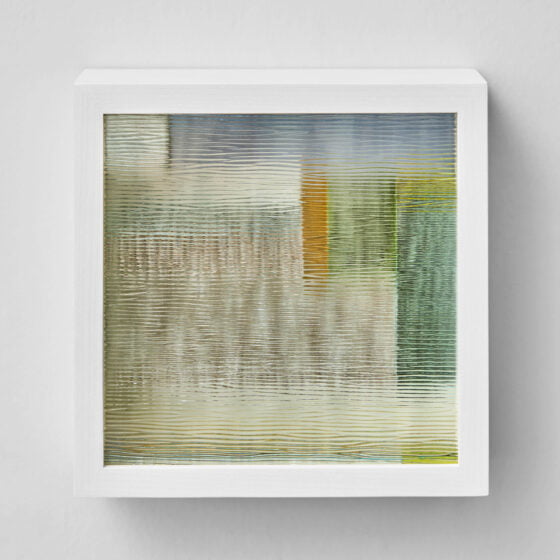
When someone asks me what I do as an artist, I say I work with glass. But what I am really working with is light, and the ways in which light interacts with glass. Glass and light are ubiquitous in our everyday lives, but none the less extraordinary for that, and the resources offered by these materials are boundless.
Each piece I make locates my visual concerns precisely within a deep frame that provides an arena – almost a theatre – where glass and light can interact in ways that I find fascinating and beautiful. This is where my curiosity is played out and where, to a degree, the effects I am experimenting with are made definitive.
Our experiences of colour and light is, necessarily, subjective. The compound eye of a bee, and the skin of an octopus, make sense of light and colour in ways that are quite unlike our own. Glass, however, is palpable and can be experienced objectively. In its molten state it can be poured and blown: when crystalline it can be scored and broken. By layering glass, as I do in my work, the material’s potential becomes limitless – one might say almost infinite