

19 Grove Park Terrace, London, W4 3QE
An exhibition which celebrates the gifted hands whose work embodies the pleasure of giving. Each piece reflects a generosity of form and spirit, offering quiet joy and beauty to enrich the rhythm of daily life. This year, our Winter Exhibition focuses on promoting young and emerging talents who have caught Joanna’s eye, alongside well-established names whose enduring creativity continues to inspire and delight.
A Time for Gifts features work by contemporary artists Helen Beard, Adam Buick, Karen Bunting, Halima Cassell, Amanda Coldridge, Prue Cooper, Steffen Dam, Laura de Santillana, Sara Dodd, Elizabeth Fritsch, Florian Gadsby, Joseph Harrington, Mark Hewitt, Paul Jackson, Petra Lindenbauer, Francis Lloyd-Jones, William Plumptre, Judith Rowe, Miranda Thomas Shackleton, and Gregory Warren Wilson.
Also exhibited are works by Norah Braden, Clive Bowen, Edward Hughes, John Maltby, Lucie Rie, Katharine Pleydell-Bouverie and John Ward.
Helen Beard graduated from Edinburgh College of Art with a BA in Design and Applied Arts with first class Hons. Following her graduation in 2001 she spent time working as an apprentice for renowned Studio Potter Edmund de Waal.
Beard has won several awards including a Development Award from Crafts Council England and Evening Standard Homes and Property Award for Best Domestic Design. Beard illustrates her distinctive works with drawings of quirky individuals and curious places. Inspired by the surroundings of her North London studio you often see the same type of characters appearing in her work such a market sellers and swimmers from the ponds of Hampstead Heath.
Created from Limoges Porcelain all of Beard’s pieces are thrown and then hand painted using techniques developed while in Edinburgh. Using stain-impregnated newspaper her freehand line drawing is transferred onto the pot in a method similar to relief print. Colour is painted over the drawing using different washes of ceramic stain, and finally the pots are dip-glazed and smoothed down ready for the final stage of firing. Each piece is a one of a kind unique vessel.


Clive Bowen studied painting and etching at Cardiff College of Art before being taken on as an apprentice by Michael Leach. In 1971 he set up his workshop in Devon and in 1976 after several firings with Michael Cardew at Wenford Bridge he built the largest wood fired kiln in the country at that time, with a capacity of 400 cubic feet.
Clive makes domestic ware in the true Mingei tradition in that he wants people to be able to replace pots if they get broken. His free gestural decoration fits so well his warm and lively pots. Never one to overstate, he remains truthful to his chosen path while interpreting his work in a painterly way.
Clive Bowen has lectured and given workshops in Israel, Japan and UK. His work is represented in the V&A, National Museum of Wales, Ulster Museum, Crafts Council Collection, York City Art Gallery, Exeter Museum, Nottingham Museum, Winnipeg Art Gallery, Canada. Joanna Bird has represented him since 1994.

Norah Braden is one of the foremost British potters of her time. After graduating with a diploma in painting at the Royal College of Art, she studied at the Leach Pottery from 1925 to 1928, where she became particularly interested in wood ash glazes. She subsequently worked alongside Katharine Pleydell-Bouverie at Coleshill for eight years, using ash glazes made from plants and wood on the estate.
She taught at Brighton and Central Schools of Art. Braden was a perfectionist, and destroyed many of the pots she made, to the extent that her work is now considered rare. She was thought by Leach to have the best eye of any of his pupils and is considered by many to have the greatest sensitivity to shape of any of the Leach pupils.

Adam Buick studied Archaeology and Anthropology at the University of Wales before embarking on a Ceramics Design and Skills course in Ireland in 2004. He uses the Moon Jar form as a canvas to map observations from an ongoing study of his surroundings, incorporating stone and locally dug clay into the work to create a narrative that conveys a unique sense of place. The use of local materials is integral to his work, reflecting a personal relationship with landscape, the materials within it and his past experiences from where materials were collected.
His work is in a number of public collections including the Devonshire Collection and the National Museum Cardiff.


Karen began making pots in the early 70s after completing a degree in chemistry at University College London and working as a computer programmer. Discovering ceramics she quickly realised her real vocation. Mainly self-taught, Karen worked briefly for a production potter in Yorkshire, then moved back to London and in 1977, set up her first pottery in Hackney, East London.
Karen made functional pottery, working in reduction fired stoneware. Each piece is first thrown or hand-built, then individually worked and decorated with stripes, spots and cross-hatches which enhance aspects of its form. The reduction firing generates muted colours, often marked out with darker lines of patterning, producing a stillness and sobriety which Karen has expressed as a quality she is drawn to. Quiet and contemplative, her work reveals its qualities to the viewer over time and through use and handling.


Born in 1975 in Pakistan, brought up in Lancashire and now living in Shropshire, Halima’s varied, multi-cultural background is tangibly present in her work. A natural creativity presented itself at an early age and was nurtured to fruition as Halima carved her way through an art-based education: an undergraduate degree in 1997 and an MA in 2002.
The culmination of this process is Halima’s precociously mature work. Fusing her Asian roots with a fascination for Mughal and African pattern work and a passion for architectural geometry, Halima’s work is intense yet playful, structured yet creative; substantial yet dynamic and invariably compelling in its originality.
In Halima’s work she combines strong geometric elements with recurrent patterns and architectural principles, her work utilises definite lines and dramatic angles. Halima concentrates on simple forms as the basis of her work in order to maximise the impact of the complex surface patterns in combination with heavily contrasting contours.
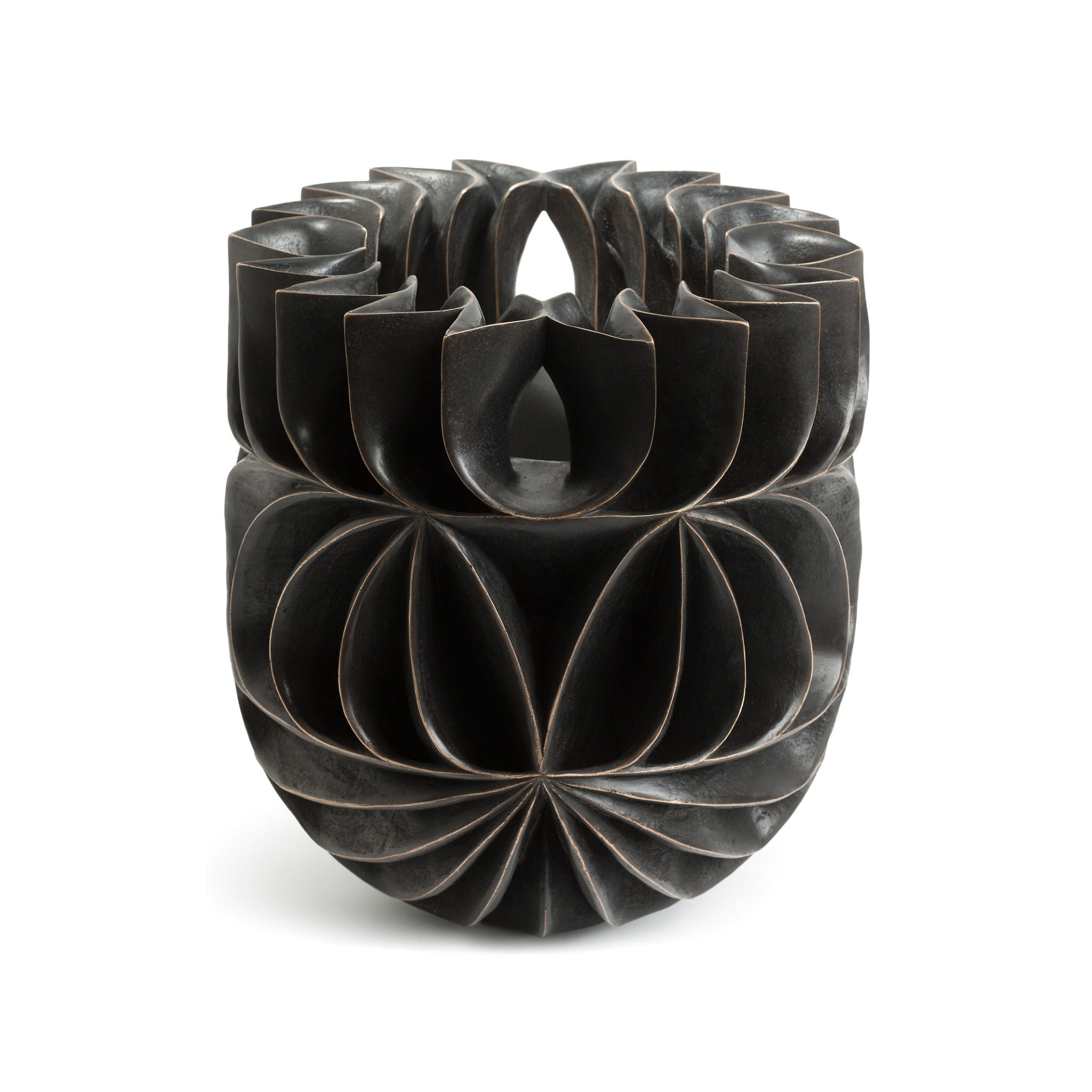

Amanda’s work is centred in nature, seasonal changes, decay and how time changes things. She observes how over time surface quality changes, objects split apart, flake off, develop mould – natural mark making and change through simple being.
Amanda started working with clay in 2006 and over the years has undertaken private tuition with a variety of experts through collaboration and study. Since 2017 she has made ceramics under the tutelage of Hilary La Force and has also attended City of Oxford College, developing throwing techniques, learning mold making and glaze mixing skills. Her work involves hand building, throwing and slip casting, often using textiles to create texture and depth.


Joanna Constantinidis was born in York and trained at Sheffield College of Art. In 1951 she became a lecturer in Ceramics at Chelmsford Technical College and School of Art, and taught there for nearly 40 years. In 1978 she was awarded the Medal of Honour at the international exhibition of ceramic art in Faenza.
In 1989 she took early retirement in order to devote herself to producing ceramics full-time. By this time her work was internationally recognised and her pieces were being shown in the United States, Belgium, Germany and Italy as well as in the United Kingdom.
Her work was influenced by British history, drawing inspiration from medieval pottery, Staffordshire slipware, salt glaze and early industry pottery. Another influence was modern and ancient Greece, with much of her work being subtly lustred suggesting sun-bronzed metal and the minimalist shapes.
Her work is represented in major collections including the Victoria and Albert Museum, London


Steffen originally trained as a toolmaker, and worked for some years as such, before realising his curiosity spanned more than that which is measurable. In glass he found these qualities. The uncompromising nature of this material exactly fitted the precise and analytic way of thinking that he was taught in constructing industrial tools.
During his first ten years of glass making, Steffen was practising and experimenting with all the different techniques to become a good craftsman. While doing so, he discovered a new kind of beauty in the fringes of the well-crafted glass he was making. In the area of mistakes and faults – the unwanted air bubbles, ash marks, soot, cracks and crookedness – he found something that could not be predicted or sketched beforehand. He set the established and traditional techniques aside and started making glass all “wrong” in an attempt to capture the good in the bad. Out of these experiments came the “Fossils”, “Plants” and other objects – like frozen extracts of chaos to be watched undisturbed.
Steffen has work in Museums and private collections internationally.


Sara was first drawn to porcelain in 2013 when completing her degree at Cardiff Metropolitan University. Seeing beauty in the fragility and delicacy of the material whilst utilising its strength Sara has used both the elements when developing her signature style.
Using slip she paints to create her wafer thin pieces of ceramic. Then using repetition she creates pieces constructed of these individual units that build up to form sculptures and wall based installations. Eliciting curiosity her work uses general notions of what ceramics is and its possibilities. Sara captures wonder and amazement for the viewer.
Sara describes her mentality while working as a meditative state, allowing her hands to work intuitively.
For Sara the firing itself is an important tool within her process. Porcelain is a high firing material and will reach a temperature of 1260 degrees celsius within the kiln. These high temperatures cause the porcelain to begin to move and shift. Sara then uses this movement to manipulate her designs and add a finishing touch to her free standing pieces. These unique sculptures capture a moment in time from the firing, immortalising the piece. Sara uses this balance of design and chance to capture freedom and individuality in her sculptures.
Her work has been shown internationally including the New York Ceramics and Glass Fair and the Royal Academy Summer Exhibition. Sara frequently exhibits in London having shown at Collect, held at the Saatchi Gallery in 2017, 2018 and 2019 and at the London Art Fair in 2019.


Florian Gadsby is a ceramicist based in London who specialises in making functional ceramics. An accomplished thrower, his finely turned architectural style defies the traditional use of the wheel and creates light, angular forms.He often complements his pieces with feldspathic, gas-fired glazes with create a rich, soothing crystalline effect.
Having been an apprentice to Lisa Hammond MBE for three years, and to Ken Matsuzaki in Mashiko, Japan, Florian has learned thoroughly how to throw with efficiency and skill, constantly striving for sensibility and functionality in his work.
To compliment his physical work, Florian has long been documenting his pottery and apprenticeships for his 1.8 million followers. He recently published his first book, By My Hands: A Potter’s Apprenticeship.


Joseph Harrington is a sculptor working predominantly in cast glass. He graduated with an MA in Ceramics and Glass from the Royal College of Art in 2006. He won ‘Best in Show’ at the 2017 British Glass Biennale, a gold medal at the Bavarian State Prize 2018 and has recently had his work acquired by the V&A Museum, London.
Joseph has exhibited both nationally and internationally including a 2013 solo exhibition ‘Landscape Portraits’ at Bullseye gallery, Portland USA and has exhibited at ‘Collect’ art fair at the Saatchi Gallery, London.
‘I interpret landscapes through exploration of material. I focus on rugged coastlines, looking at erosion as a spectacle of discovery and generation of form, revealing a sense of the history and movement of a place.
The work is produced using my ‘Lost Ice Process’: I use salt to sculpt ice as a one-off ephemeral model to take a direct cast from. The textures this provides and the transient nature of the creative process reflects the erosion and sense of time I want to represent in the landscape. There is a roughness from the initial cast that is ground polished and refined to its final finish, revealing the internal structures of the glass and creating facets and flat planes to redefine the essence of the made against the organic surface.’


Born in Stoke-on-Trent, England, Mark is the son and grandson of directors of Spode, the fine china manufacturers. As a student in the early 1970′s, Mark read Bernard Leach’s “A Potter’s Book,” and decided to become a studio potter rather than an industrial manager. This decision led to a three-year apprenticeship with Michael Cardew, and later another with Todd Piker in Connecticut.
In 1983, he moved to North Carolina to set up a pottery. Mark built his own vast wood kiln and began making distinctive functional pots, specializing in very large planters and jars. He uses local clays and blends different North Carolinian and English folk traditions together into a contemporary style.
Mark’s work has been featured in numerous publications including the Smithsonian magazine, American Craft magazine, and he has written extensively in the ceramic press. Mark has exhibited in London, New York and Tokyo, as well as throughout the US. He is well-represented in museum and private collections. Mark co-curated the highly-regarded exhibition, The Potter’s Eye: Art and Tradition in North Carolina Pottery at the North Carolina Museum of Art, which was accompanied by an illustrated book. In 2017, he curated a show and edited the accompanying book at North Carolina Pottery Center entitled Great Pots from the Traditions of North and South. Mark and his work have also featured extensively in the nationwide PBS TV series, Craft in America.
Mark has received numerous awards. In 2013 he received the Sam Ragan Award from St. Andrew’s University for contributions to the Fine Arts of North Carolina. He was awarded the 2014 Voulkos Fellowship by the Archie Bray Foundation for outstanding contributions to the ceramic arts. Twice, in both 2013 and 2014, he won Best In Show at the North Carolina Botanical Garden Sculpture in the Garden exhibition. Mark was one of five finalists for the 2015 American Craft Council’s Balvenie Rare Craft Award.
Mark is past President of the Board of Directors at the North Carolina Pottery Center.


Having graduated from Bath Academy of Art, Edward studied as a postgraduate student on the Japanese Government Scholarship at Kyoto City Art College from 1977 to 1979. He was awarded the Tomimoto Kenkichi Prize for Domestic Pottery at the college’s graduation exhibition.
Following his studies, Edward established his first pottery studio at Shiga, mounting his first solo exhibition at Osaka in 1979. Exhibitions in Tokyo, Kyoto and Osaka became annual events until his return to England in 1984 to set up his studio in Cumbria.
Edward made reduction fired stoneware and porcelain, mostly slip decorated and glazed with locally obtained wood ash glazes. The pottery mark stamped on all of his work incorporates, in addition to his initials, the Japanese characters Earth and Fire, signifying the basic elements of the potter’s craft.


Paul Jackson qualified in Studio Ceramics at Harrow School of Art, under celebrated ceramic sculptor Mo Jupp. He graduated in 1977 and, following a short period of teaching in London, relocated to Cornwall, where he established his pottery in 1979. In 1989, he moved to Helland Bridge, where he worked in a studio converted from an old chapel. Recently, Paul has moved to a new studio on the North Cornish coast at Tredrizzick.
Paul works primarily in white earthenware to construct his energetic and sinuous forms. Each piece is first thrown on the wheel, then subtly altered into fluid and expressive forms. The clay allows for the dynamic shaping of the piece, which lends itself to a diverse range of bold and colourful decoration. Recently, Paul has diversified his working methods, using local stoneware and porcelain in a salt glaze kiln.
His recent work shows the influence of Russian and Islamic art. In particular, one sees reflected in Paul’s work the geometry of the early 20th Century Russian avant-gardists, the Rayonists and Suprematists, who sought to capture the supremacy of pure artistic feeling. At the heart of his practice is a sense of energy and movement that captures the vivid colours and character of the Cornish landscape.


Petra began her ceramic education in 1983, in the Department for Ceramic Arts at Ortwein School in Graz, Austria, though her interest began much earlier. Petra is the daughter of a wood and stone sculptor: “after school, I did my homework in my father’s studio. As soon as I was finished, I opened the chest where the clay was kept for making models. From this clay, which was often dirty and coarse, just like a sculptor needs, I made vessels and small reliefs, which my father then cast in plaster”. Following her studies in Gras, Petra undertook a degree in the History of Arts and Classical Archaeology at the University of Vienna, graduating in 1998.
Petra’s academic and artistic career has led her to a complex understanding of being a ceramicist: ardent studies of the different approaches to working with clay, from Japan and China to the Middle East and Europe, and the ongoing participation in symposia, workshops and exhibitions worldwide have lended her practical work an expressiveness that brings together Eastern Asian techniques with a Central European understanding of form.
Petra is a member of the International Academy of Ceramics (IAC) and of Associazione Pandora Artiste Ceramiste.


Francs Lloyd-Jones initially studied Fine Art at Chelsea College of Art. After completing the two year Ceramic Skills and Design Course in Thomastown, Ireland, he went straight on to work at Maze Hill Pottery as an apprentice to Lisa Hammond, finishing in January 2022. He is a selected member of the Craft Potters Association and was short listed for the Heritage Crafts Trainee of the Year 2021. Recent group exhibitions include: Ones to Watch, Clay College Stoke, Ash Ember Flame, Embassy of Japan; Future Perfect at Make, Hauser and Wirth, Somerset. He is currently based in Cumbria as the resident potter for Grizedale Arts, an arts organisation underpinned by the philosophy that art should benefit wider culture and society.


“I imagine within me a dormant sense of ‘Englishness’ of which I am neither too consciously aware, (nor certainly reluctant to cultivate self-consciously). It is only in retrospect, and my looking at a group of sculptures made specifically for a particular exhibition, that ones preoccupation with subject, and a certain ‘spirit’ which might be called style, and which is inescapable, becomes clear.
Texture is reminiscent of weathered and aged rock and place: a sense of our history. A timeless and seamless link with our past, yet objects which (often with wry humour) are firmly anchored in my immediate present.”


Working by the sea in Hastings, artist and potter Judith Rowe makes a wide range of earthenware. She uses traditional techniques which she learned under Eddie Hopkins in the renowned Winchcombe Pottery in Gloucestershire.
Judith has established nature as the central motif which permeates her work both metaphorically and literally, since she decorates her cups, jugs and bowls with birds and plants and regularly throws pots with clay that she collects from the shore’s surface at low-tide. Loving nothing more than to be on the beach or in the fields, she decorates her earthenware using oxides and paints that mirror the greens, greys and blues of the sea and surrounding landscape. Judith has cited Minoan terracotta pottery as her biggest inspiration.


Born in Vienna, Lucie Rie (née Gomperz) studied ceramics at the Wiener Kunstgewerbeschule under Michael Powolny and Robert Obseiger from 1921 to 1926. She showed her work in various exhibitions concerned with the products of the Wiener Secession, including the Paris exhibitions of 1925 and 1936. She arrived in England in 1938 and established her studio in Albion Mews, West London, where she remained for the rest of her working life.
Her earliest English works were ceramic buttons, brooches and tableware, which she made with the assistance of Hans Coper after the Second World War. However, once wartime exigencies and immediate post-war austerities were over, Rie was free to develop her work, bringing to it an infallible sense of style combined with a certain ‘English’ sense of balance between form and surface.
Even after Hans Coper left to set up his own studio in 1958, they continued to exhibit together and their work, although very different, represented a new departure from the Eastern influences that until then had been the British studio potter’s sole source of reference. Lucie Rie’s work is to be found in numerous major public collections, as well as many private ones.


Miranda Thomas is a renowned potter based in Vermont, born in New York but raised in Italy, Australia, and England. Introduced to pottery at the age of 16, she has since apprenticed and worked with some of the world’s most notable potters, including Michael Cardew CBE, with whom she received her most significant training, as well as Alan Caiger-Smith.
Her pottery is collected in hundreds of homes, including those of celebrities and dignitaries. She has designed diplomatic gifts for President Barack Obama, Vice President Joe Biden, UN Secretary Generals Ban Ki Moon and Kofi Annan, and the Clinton Administration, including former President Bill Clinton’s gift to Pope John Paul II, as well as pieces for The United Nations Association, The Loomba Trust, and London’s Ritz Hotel.
Miranda’s designs draw from the English countryside, as well as using symbolism and patterns from ancient Japanese, Middle Eastern, and Aboriginal designs, among other international influences.


In 1966 Ward was accepted onto the Camberwell School of Art and Crafts Ceramics course after developing a fascination with pottery during Adult Education classes. After graduating he worked as a part time pottery teacher in London while also developing his studio. In 1979 he moved to Pembrokeshire where he still resides and works.
‘There is something compelling about the making of pots, regardless of function, which keeps me within the particular sphere; they are the focus of some many interests and associations. My aim is to make pots which have simple forms with integral decoration and aspects which can interact with the environment in interesting ways; to try and express a balance between these dynamic qualities and a sense of stillness or containment. Form above all, but expressed through light and colour’ – John Ward

Gregory Warren Wilson’s brilliantly colourful and innovative work in glass plays with the translucent nature of the material. Each piece is conceived on multiple layers – sometimes as many as six – and these layers allow light to interact with the glass spatially, penetrating the depths within each frame. The designs he makes sparkle and scintillate, and they appear to move as you look at them.
Warren Wilson’s work is, in part, sculptural. Each piece can only exist in three dimensions, and the glass interacts with the play of light spatially. His work invites the eye to exult in pure colour, and also to investigate the mysterious depths of the space that the designs inhabit within their bespoke frames.
Having lived for many years in Italy and Australia, light is crucial to his work as an artist. The tesserae he uses are hand-cut in Murano, and the irregularity of each unique piece enlivens the surface of his work, refracting light in ways that are eye-catching and unpredictable. Each of his designs is made with great precision so that the individual tesserae reflect and refract light in an extraordinary variety of ways.
Warren Wilson is a prize-winning poet. He has published five collections and was awarded an Arts Council Grant in 2008. A number of his glass designs take as their starting point a fragment of poetry. Over time, his visual response develops into a ‘correlative’, resulting in a glasswork that exists in its own right, while alluding, albeit obliquely, to the original literary source.


